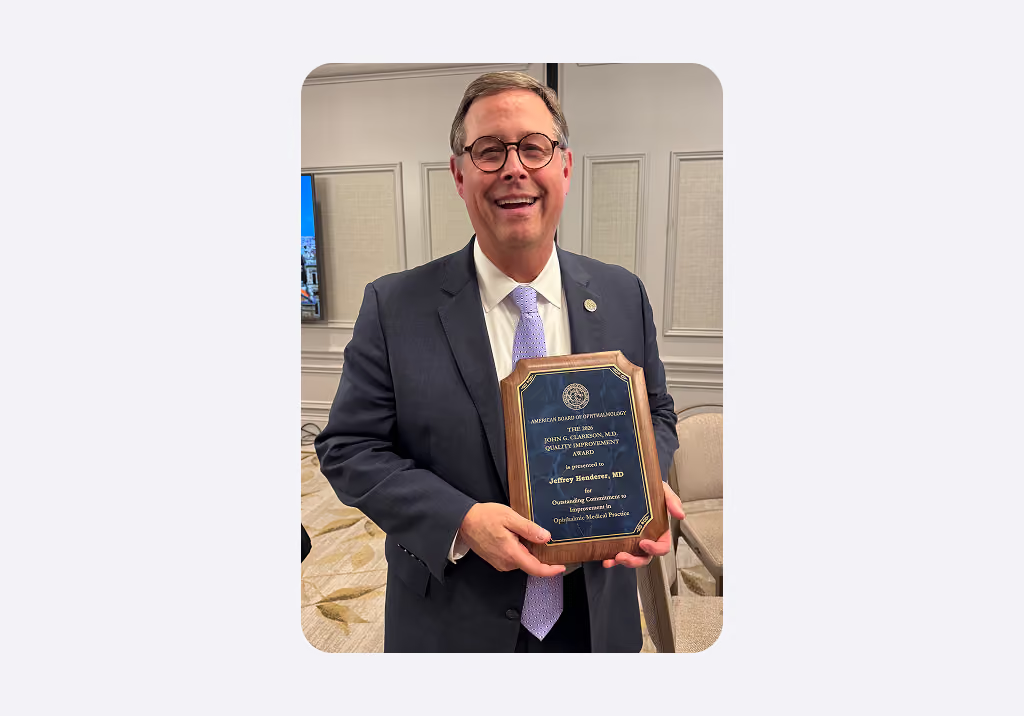
Temple ophthalmologist recognized for a diabetic eye screening program powered by Eyenuk’s EyeArt autonomous AI

Eyenuk congratulates Jeffrey D. Henderer, MD, on receiving the 2026 Clarkson Quality Improvement Award from the American Academy of Ophthalmology (AAO) and the American Board of Ophthalmology (ABO)
Henderer is the Dr. Edward Hagop Bedrossian Chair and professor of ophthalmology at the Lewis Katz School of Medicine at Temple University, Philadelphia. The Clarkson Award recognizes his efforts to bring diabetic retinopathy screening (DR) to primary care, a project in which Eyenuk’s EyeArt® AI system — the first and only FDA 510(K)-cleared autonomous AI that detects vision-threatening DR — played a major role.
"The goal is to develop a screening model that is sustainable. Using EyeArt, we can reduce the cost per exam which allows more screenings to be done. It also means that when a patient fails the screening they are much more likely to require treatment which brings a constant stream of patients into the ophthalmology practice." - Dr. Henderer, MD
The Compliance Problem
DR is a leading cause of preventable vision loss. However, Henderer has noted that screening compliance is only between 50-70% (source). Globally, those numbers fall as low as 39.3% in low- and middle-income countries. He noted that people value their visits with primary care providers (PCP) and concluded that screening should happen right there in PCP offices.
At Temple University Physicians, Henderer’s team first set up a retinal camera so an internal medicine medical assistant could take photos and send them to optometrists for remote review.
Unfortunately, this approach didn’t quite work in practice. Manual image review caused delays and inconsistent reads, and only 18% of patients who failed their screening were even scheduled for a follow-up eye exam. The team hired a dedicated care coordinator who helped raise the scheduling rate to 66%; however, the bottleneck remained.
That's when Eyenuk came into the picture.
Reshaping Patient Care with EyeArt
During the COVID-19 pandemic, Henderer’s team redesigned the program using the EyeArt system. This allowed the primary care team to quickly receive a DR result in about 10 seconds compared to several days with manual image review. That allowed the patients to learn their results immediately from their trusted providers and understand why a follow-up with an ophthalmologist is so important. Moreover, the screenings were billed to CPT code 92229, a new code for FDA-cleared autonomous DR screening, created and implemented by the AMA and CMS in collaboration with Eyenuk.
The combination of EyeArt and the screening coordinator increased the follow up completed exam rate from 10% to 43%. While there is still room for improvement, this was a significant step forward.
Yi Zhang, MD, PhD, associate professor of ophthalmology at Temple and the project’s vice chair of research, commended Henderer’s vision and leadership, calling the program a strong example of how AI can reshape patient care in ophthalmology and across all of medicine.
Gaurav Agarwal, CEO at Eyenuk, had this to add:
"What Dr. Henderer built at Temple shows what it takes to make diabetic eye screening work in primary care. He and his team at Temple did the hard work of making screening practical, and kept refining it until it worked for patients. We are proud that EyeArt is part of the program and grateful for everything we have learned from working with him. We congratulate him on a well-deserved honor."
A Model to Duplicate
Thanks to positive responses from his primary care colleagues, Henderer hopes his model can be adopted by other health systems. In fact, he’s working with the AAO on a pilot project in Delaware, again using Eyenuk’s EyeArt system.
Henderer’s ideal of efficient DR care to all who need it reflects Eyenuk’s mission: to prevent vision- and life-threatening disease and advance systemic health through retinal AI.
We congratulate and thank Dr. Henderer for leading the way to ensure that patients do not experience vision loss that could have been prevented with early access to care.
Read EyeNet Magazine's article (PDF) about this award. AAO members can also read online.
Dr. Henderer is a consultant to Eyenuk.
About Eyenuk
Eyenuk is a global digital health technology company and leader in autonomous disease detection. Driven by our mission to prevent vision- and life-threatening disease and advance systemic health through retinal AI, our flagship EyeArt® system delivers rapid, autonomous retinal screenings at the point of care with regulatory clearances tailored by region. In the United States (FDA 510(k)) and Canada (Health Canada), EyeArt is cleared for autonomous diabetic retinopathy (DR) detection. In the European Union (CE MDR), Colombia, Ecuador, and Australia (TGA/ARTG), it is authorized to detect signs of diabetic retinopathy (including diabetic macular edema), age-related macular degeneration (AMD), and glaucomatous optic nerve damage. Backed by SOC 2 Type 2, GDPR, HIPAA, and MDSAP/ISO 13485:2016 certifications, Eyenuk partners with healthcare providers worldwide to protect sight and advance systemic health.